Saturday, 22 October 2016

Back to tradition with a batch of cheese scones

After last week's exotic excursion to South America, this week I felt like baking something simple (jet lag) and traditionally English. And what's more English than scones? My youngest sister Hatty makes the best scones in Yorkshire - maybe the best scones in England but it's hard to tell because they never last long enough to make it out of Yorkshire. If you want one/three, you can get them in her cafe, the Jam Jar in Ripon. I think cheese scones make a regular appearance on Thursdays, which is market day.

People often ask Hatty for her scone recipe, expecting it to be some long held family secret. In fact, it's from the free recipe book that comes with Be-Ro flour, although no one ever believes it. And as you'll see from my attempt, there's clearly some other magic involved...

Mum's had a well-thumbed copy of this book for as long as I can remember (i.e. the 70s!); my copy is a bit newer but the recipes are exactly the same.


Ingredients
(makes about 8)

175g self-raising flour
1/2 tsp mustard powder
Pinch of salt and pepper
25g butter or margarine
75g grated cheese
1 egg
2 tbsp milk


Method

- Mix the flour and seasonings together, then rub in the cold fat


- Stir in the cheese, keeping a bit to sprinkle over the top


- Mix together the egg and milk, then add to the dry mix to make a soft dough


- Roll out and cut out, either triangles or using a fluted cutter (but see the Tips section later on this). Brush with a little milk or egg and sprinkle with the leftover cheese


- Bake at 220C for 10 to 15 minutes until golden brown.


Now embarrassingly, you'll notice that despite the camera angle, these scones are biscuit flat! 


The Bearded Argentinian assures me that they taste delicious, but if I want to practice with a few more batches, he'll do his best to test them all. There I was thinking that scone-making was in my genes, and out come these failures... So I did a bit of research:

Tips for not making flat scones:

- Firstly, I had no idea there was such variety in recipes: raising agents, flour types, eggs vs no eggs, lard vs butter vs margarine...
- Most likely, the butter had something to do with it, as I only had spreadable butter to hand, and cold hard block butter is probably better
- Consulting the scone oracle Hatty, you don't need to roll them out either, just pat the dough down and leave them much thicker (can't believe this is against what the BeRo book says!). Then they might turn out more like these beauties:


Sunday, 9 October 2016

Four Hobs on the Road... and someone turns 70

It may come as a surprise, but the Bearded Argentinian is actually from Argentina and not Mexico as commonly mistaken. This week we are are visiting his parents in Buenos Aires, as his Dad turns 70, which is link enough for a 70's blog in my opinion. Below is the "recipe" for an asado, the closest translation being barbecue, but as you'll see, this is a million miles away (literally) from charcoal incinerated burgers...

The first step in this recipe is "Go to Argentina" as you'll never get the right quality or cuts of meat anywhere else. Also you need one of these:


I'm referring to the parilla, a brick construction found in pretty much all Argentinian gardens (not the man, who is Carlos, the birthday boy himself).

This asado took place two days before the big event (which was 4 times bigger) and was a kind of Sunday lunch for the family, including our friend Nico, who abandoned his wife and children for the weekend and travelled over 900 miles from Patagonia just to help us eat all this food.

Ingredients 
(serves 5, with leftovers)

10 chorizos
1 morcilla (a large sausage of black pudding)
Many kilos of asado (beef rib)
Many kilos of pork rib

Method

- Make a fire at one end of the parilla with dry wood (not green wood, which smokes too much. Yes, I have been lectured on this topic). Look, there's a separate bit for the fire:


- As the wood burns, move the hot white ashes from the grate of the fire to the grill. It takes about 2 hours to get enough ashes to start cooking. I strongly suggest opening a beer. 

- Add all the meat to the grill. The bars of the grill are v-shaped so that the fat runs away from the meat. I'm not proposing this is by any means healthy, but, you know, it could be worse...


- While the meat is cooking, have some picada - this basically means "food to pick on" so is usually cut into handy bite size pieces, and can be cheese, salami, olives, aubergine, breadsticks etc. Try really hard not to eat too much though, there is a lot of food coming.


- When the meat is golden brown on the bottom, turn and keep cooking. I'd be very surprised if you're not already on your third beer by now - it's thirsty work.


- Serve the chorizo and morcilla first, with green salad, potato salad and chimichurri. Oh, and some Malbec (nearly forgot, must be all the beer)


- Next, serve the beef..


... then finally the pork.


- Invariably, the meal will be followed by an intense conversation about politics and/or football. This is called "sobre mesa", literally "over the table", and is a good opportunity for non-Spanish speaking guests to quietly slip into a meat coma. I usually only respond to "un poco de vino tinto?" during this stage.

- Finish off with 6 flavours of ice cream. Not a choice of 6, a scoop of each. I'm not even joking. Here's an unrelated photo of our Goddaughter Amandita elegantly eating an ice cream:


Buen apetito! You might also need the phrase "estoy llena"... (I'm full!). Note, you will be asked at least three times if you're sure about this. 

Cook's tip: as a shortcut, just make friends with an Argentinian and they'll do all this hard work for you. I should point out that the Bearded Argentinian is *more than a friend* but there's no need to go to extremes.

Thursday, 29 September 2016

Accidental bake off spin off: meringues

This week I thought I'd go back to basics and make meringues. I wanted to make them like my Granny used to, slightly chewy in the middle, so I used my newly acquired 1976 St Michael* "All Colour" cookery book, supplemented with some tips from Perfect Felicity Cloake. 


I can't tell you how rare it is to find a 70s cookbook with photos in! 


*St Michael used to be the M&S food brand for those too young to remember. And was always written in italics.

Ingredients

4 eggs whites (large) - possibly left over from making ice cream, see later
200g golden caster sugar
1/2 lemon


Method

- Spread the sugar on a lined baking tray and cook in the oven at 200C until melting at the edges. This makes the resulting meringues slightly beige rather than pure white but is worth it for the flavour

- Wipe the inside of a very clean bowl with the half lemon to remove any grease so the egg whites whisk up properly

- Whisk the egg whites (with a gadget if you have one) until foamy, then add the hot sugar, keeping the whisking going until the mixture is glossy and holds it shape 


- Spoon or pipe the mixture onto a lined baking tray and bake in the oven at 100C for 3 to 4 hours. This might be the lowest setting for your oven, and if they start to brown, open the door to cool down. If your oven is like mine, 60C is the "lowest setting" and they never cook at that temperature so turn it up a bit! 


I had nothing to do for 4 hours so here's a photo of them in the oven...


 - Serve with whipped cream or ice cream.  At the Bearded Argentinian's request we had made chocolate and dulce de leche ice cream (using lots of egg yolks, hence the egg white glut) which went brilliantly with the meringues, either as a classic sandwich combo or as a crumbly topping.


Meringues can be tricky (she writes, never having made them), but these turned out perfectly crunchy on the outside and a bit chewy tight in the middle. Hopefully those people on GBBO who struggled with their meringue in this week's Signature Bake have picked up some tips ;)

Having conquered the basic meringue, I might graduate to lemon meringue pie or even basked Alaska - watch this space!


Monday, 12 September 2016

Beef olives: a 70s excuse to use a blender and a freezer

This could also be known as 'beef olive surprise', as there are no olives involved at all. It must have been a popular dish though, as it's in both The Penguin Freezer cookbook (1973) and The Mixer and Blender cookbook (1972). No freezers or blenders needed either - I'm going to have a word with trade descriptions from the 70s...


Ingredients:
Serves 3 (a bit random but my sister was staying...)

3 slices of braising steak
1 onion
2-3 slices white bread or equivalent in breadcrumbs 
1 lemon
1 egg
1 small handful sage leaves
1/2 pint beef stock
2 tsp cornflour (or gravy granules)


Method:

- Bash the steaks flat with a rolling pin or meat mallet until about 1/2 cm thick


- Fry the chopped onion in a little olive oil to soften 


- Blitz the bread in a mixer/blender (!) to make breadcrumbs then add the grated lemon zest and juice, half the softened onion, the egg and the sage. Season and mix together.


- Add a tablespoon of stuffing to each flattened steak and roll up, securing with a cocktail stick


- Brown the 'beef olives' - they look nothing like olives - in the pan the onion were cooked in, adding back to rest of the onions and the stock when browned.


- Cover and simmer for 1-1.5 hours. Chill out for a bit


- Take the beef olives out of the plan and thicken the sauce with a little cornflour in water or some gravy granules (ie cheat).


- Serve the beef olives and gravy with mash or dauphinoise potatoes if feeling posh (I was) and some green veg (again, kale being the posh option)


The verdict?
Sister: yummy; would have been even better with olives in it (cheeky)
Bearded Argentinian: yummy; not sure the meat was the right texture (it was very soft - which I liked but the meat expert wasn't convinced).

And if you're wondering where the freezer came into it, the freezer cookbook says you can use frozen beef, but defrost it first (genius)... There are a lot of tenuous links in that book.


Monday, 29 August 2016

Sourdough ciabatta

So what on earth is 70s about sourdough ciabatta? Well, it's a tenuous link I grant you, but Italy did exist in the 70s, and so did sourdough, it just wasn't cool. They call it artistic license, or in this case, license...

My sourdough journey began last Christmas with a voucher from the Bearded Argentinian for a bread making course in Hackney (where else?), although it was June before I managed to go. The course was at E5 Bakehouse near London Fields station, a short Boris Bike-ride away (only once again there were no bikes at the Barbican, so I had to get the bus). It was run by head baker Eyal and I can't recommend it enough - 6 hours of patient tuition, demonstration and hands on practice resulting in 4 bagels, 3 ciabattas, 1 rye loaf, a ball of "Hackney wild" dough to bake at home, a pot of Jeff (my sourdough starter), a banneton proving bowl and a dough scraper. I didn't bother trying to Boris bike home with that lot strapped to the handlebars! 


The Hackney Wild is probably the tastiest loaf we made but takes 4 days to make, and this ciabatta is so delicious, even just dipped in olive oil. You'll need a sourdough starter, either by making one from organic flour and water, or asking someone kindly for a portion of theirs.

Ingredients

makes 3-4 loaves - sounds like a lot but trust me you'll eat it

130g leaven, made from 20g starter, 90g water and 90g strong white flour, left overnight.
250g lukewarm water
3.5g dried yeast (half a sachet of fast acting yeast)
20g olive oil 
330g strong white flour
8g sea salt


Method

- Add the water, yeast and olive oil to the leaven and mix together using one hand and squishing it through your fingers

- Add the flour, mix and leave at room temperature for 20 minutes

- Sprinkle on the salt and mix in, using a bit of water to dissolve it, and leave for 30 minutes

- Drizzle olive oil around the side of the bowl and scrape the dough into a ball in the middle using a dough scraper. Then use a stretch & fold* technique to "knead" the bread for a couple minutes. Leave for 30 minutes and repeat twice more. The dough will become silkier and smoother with each round.


*stretch & fold was the most valuable takeaway from the class for me and you'll probably have to go yourself to learn it. It involves holding the dough with one hand, stretching it out away from you with the other and folding back in. I don't know why this is different from kneading but it works - you can feel the gluten strengthening with each stretch.

 - Oil the work surface, pour the dough out and knock into an oblong. Fold over itself in thirds, turn 90 degrees and fold again. Rest for 45 minutes.

- Now flour the work surface (yes this is all delightfully messy) and stretch the dough out. Cut into 3 or 4 loaves and prove on a lined baking tray for 60 minutes


- Bake at 230 degrees for about 20 minutes


- Enjoy while still warm with the best quality extra virgin olive oil you can get your hands on. I'm also a massive fan of this year's cheese of the moment, Burrata, which seems to be in every menu going but goes brilliantly with this bread


Tuesday, 16 August 2016

Celery soup (aka Barbican party leftovers)

Remember the stuffed celery from last week's 1970 Barbican party? Well I didn't stuff all of it - I should have done because a) it was surprisingly popular and b) what on earth am I going to do with half a head of celery? Not eat it raw, obviously, it's disgusting. Just as fruit salad shouldn't be classified as pudding, food that takes more calories to eat than you get from eating it shouldn't be classified as food.

So it's back to old favourite Delia and her matching orange-pan-and-cardigan combo on the evening standard cookbook, for some celery and nutmeg soup in the hope that all the other ingredients disguise the taste of celery...

Ingredients 
(for 2, or 1 person twice if no one else will risk it)

Leftover celery
1/2 large onion
2 small potatoes
250ml vegetable or chicken stock (from a cube)
125ml milk
Nutmeg


Method

- Wash the celery well, peel off any stringy bits and chop small. Also chop the onion and potato (no need to peel the potato)

- Cook the onion and potato in some butter for a couple of minutes then add the celery. season, cover and leave to sweat for 10 minutes (look - 3 out of 4 Hobs in a row!)


 - Pour in the stock and milk and simmer for another 30 to 40 minutes, then carefully blend with a soup stick


- Serve with a dollop of Greek yoghurt, grated nutmeg and some toasted flaked almonds. This should just about cover up any taste of celery - enjoy!


Saturday, 13 August 2016

Celebrating in 1970

Our flat is in the first Barbican block to be completed in 1969, so when we moved in we danced to a 1969 soundtrack whilst sitting on the floor eating pizza... One year on, we didn't just update the playlist but added a 1970 menu to complement proceedings. Fortunately our friends are lovely enough to eat pizza sitting on the floor and eat random homemade 1970s experiments...


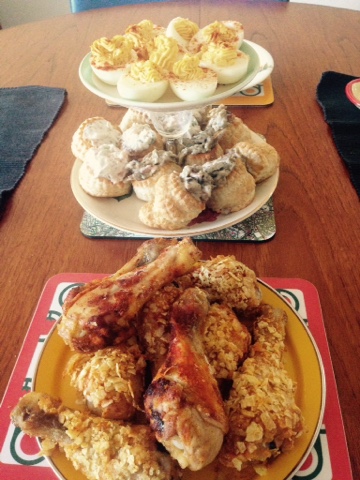
The menu
(in photos from top to bottom)

- Devilled eggs: providing huge amusement to Dr Hill with piping bag "egg farts"; note sprinkling paprika over them hides terrible piping technique
- Ham & mushroom vol-au-vents and Salmon & cream cheese vol-au-vents: incredibly easy with shop bought puff pastry
- Crunchy crisp chicken: photographed twice as so amazing, from Zena Skinner
- Stuffed celery: one of the surprise favourites of the evening
- Cheese and pineapple hedgehog underpinned by half a grapefruit as instructed by Auntie Katherine
- Porn star martinis which sound so 70s they count
- Garlic potatoes (from the familiar Delia's evening standard cookbook; basically baked potatoes stuffed with Boursin, no photo as I was making them during the party and forgot)
- and of course Prawn cocktail (detailed below)


You'll be relieved to know that I'm not going to do the recipes for all the dishes, and Zena Skinner's crunchy crisp chicken will get its own post as it rightly deserves (yes, it is chicken coated with actual crisps!).

Prawn cocktail recipe

Marie Rose sauce:

Tomato ketchup
Mayonnaise
Worcestershire sauce
Tabasco


I wasn't in a measuring mood, so the sauce is roughly half and half tomato ketchup mixed with mayonnaise, with a couple of splashes of Worcestershire sauce and a few drops of Tabasco. Build the cocktail with some crispy lettuce, plump peeled pink prawns and the sauce either on the side or over the prawns. Or a combo of the two as below (dropped some prawns in the dip). Top tip: buy a small packet of fancy looking prawns and add them last and everyone will assume all the prawns are posh and you are an incredibly generous hostess.


Enjoy with a dollop of nostalgia and sprinkling of closest friends.